Frame & Ledger · 400TX · Pricing Stock

Exposures 01 – 36

A field guide for working photographers

Priced to Book.

Stop guessing at your prices. A method for building three packages, writing the terms that protect your calendar, and handling the conversation when you raise your rates.

Priced to Book.Edition 01 · 2026

12 real spreads below · nothing blurred, nothing watermarked


$58 NZD · One payment

Digital download · No shipping · No subscription

PDF, 46 pages · Link arrives by email


  • 11 Frames
    (chapters)
  • 04 Print-ready
    worksheets
  • ~90 Minutes
    front to back
  • Digital Download link by email
  • Print-ready Four worksheets, US Letter
  • About 90 minutes Read once, reopen at the worksheets
  • 14-day refund Keep the file either way

FR 00 · Introduction

You are not bad at pricing. You were never shown how.


Most photographers set prices by opening three or four nearby websites, failing to find any actual numbers, picking something slightly below what they guess the average is, because charging less feels safer than charging more, and then living with that number for two or three years, wincing every time they say it out loud.

Pricing is a craft, the same as light is a craft, and nobody teaches it.

FR 01 · What a shoot actually costs you

A $350 session is not $350 an hour.

Walk one job end to end. The inquiry email, the follow-up, the call. The location scout. Prep and packing the night before. Travel both ways. The shoot. Card backup, culling six hundred frames down to forty, editing the forty, building the gallery, writing the delivery email. Then the "could you just tweak number 17" message a week later.

The contact sheet

Twelve frames off the roll.

Every page here is a real page. Nothing blurred, nothing watermarked, nothing staged on a floating tablet. Open any frame to read it at full size.

  1. Cover · 400TX 01 Cover · 400TX
  2. Contents 02 Contents
  3. FR 00 · Intro 03 FR 00 · Intro
  4. Part I opens 04 Part I opens
  5. The hours table 05 The hours table
  6. FR 02 · The floor 06 FR 02 · The floor
  7. FR 04 · Menus 07 FR 04 · Menus
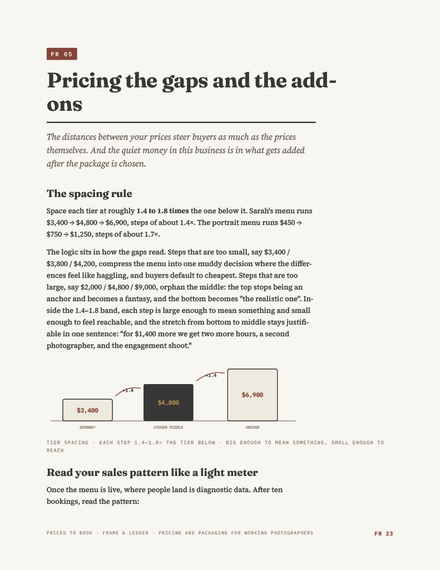
  8. Tier spacing 08 Tier spacing
  9. FR 08 · Scripts 09 FR 08 · Scripts
  10. The reset 10 The reset
  11. Worksheet 01 11 Worksheet 01
  12. End of roll 12 End of roll

Marked frames are the ones built to print and keep beside the desk

Get the guide · $58

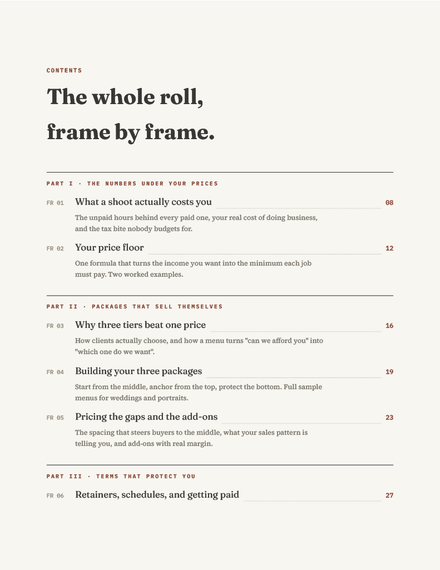
Contents · Exposures 01-36

The whole roll, frame by frame.


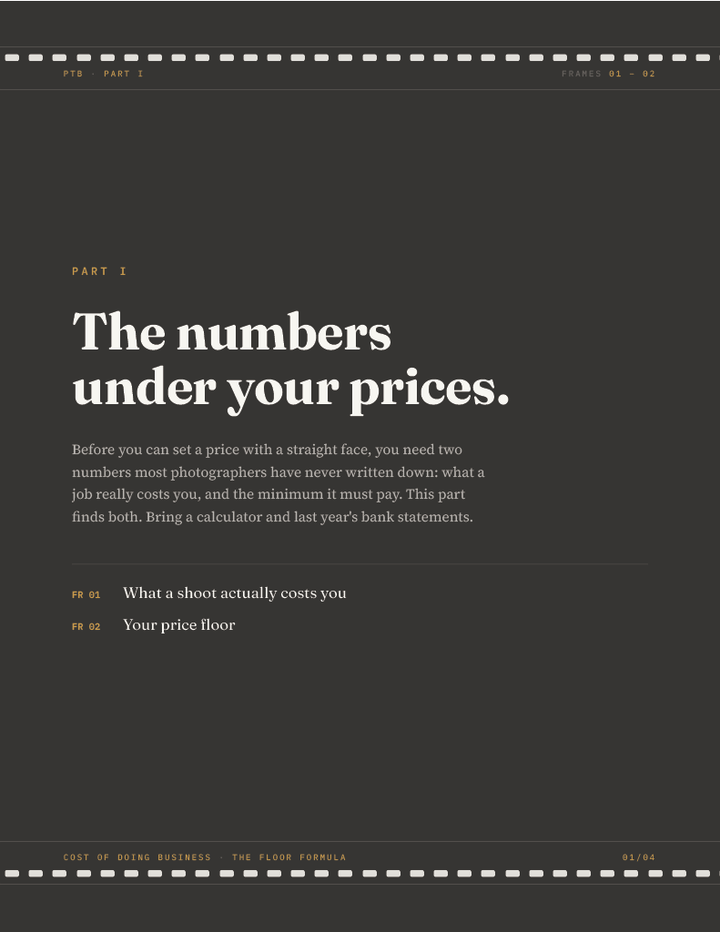
Frames 01-02The numbers under your prices.

Part I

The numbers under your prices.

Before you can set a price with a straight face, you need two numbers most photographers have never written down: what a job really costs you, and the minimum it must pay. This part finds both. Bring a calculator and last year's bank statements.

  • FR 01 What a shoot actually costs you
  • FR 02 Your price floor
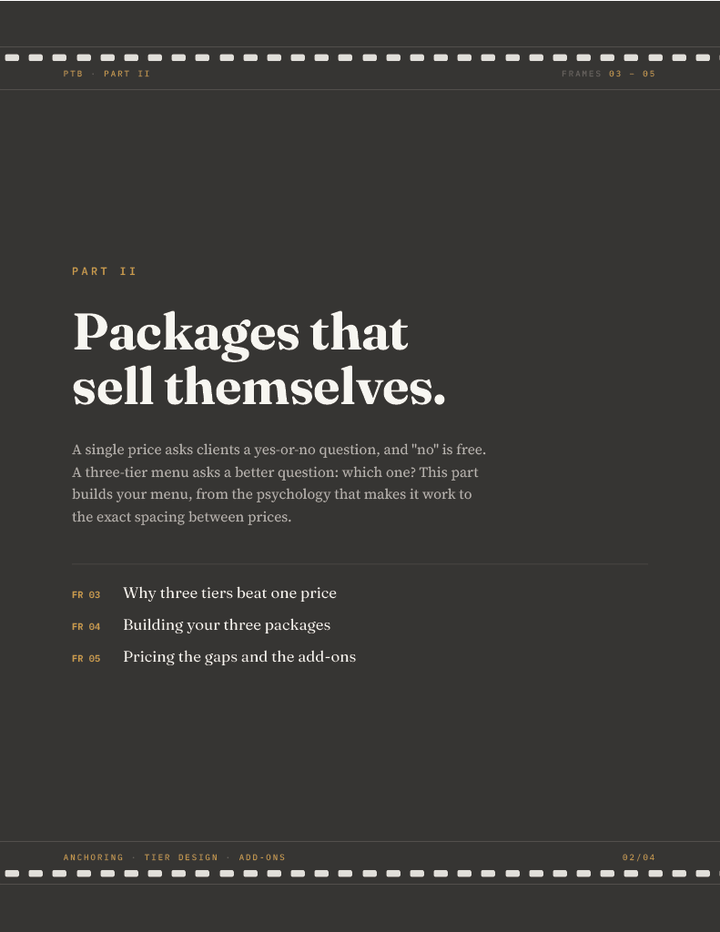
Frames 03-05Packages that sell themselves.

Part II

Packages that sell themselves.

A single price asks clients a yes-or-no question, and "no" is free. A three-tier menu asks a better question: which one? This part builds your menu, from the psychology that makes it work to the exact spacing between prices.

  • FR 03 Why three tiers beat one price
  • FR 04 Building your three packages
  • FR 05 Pricing the gaps and the add-ons
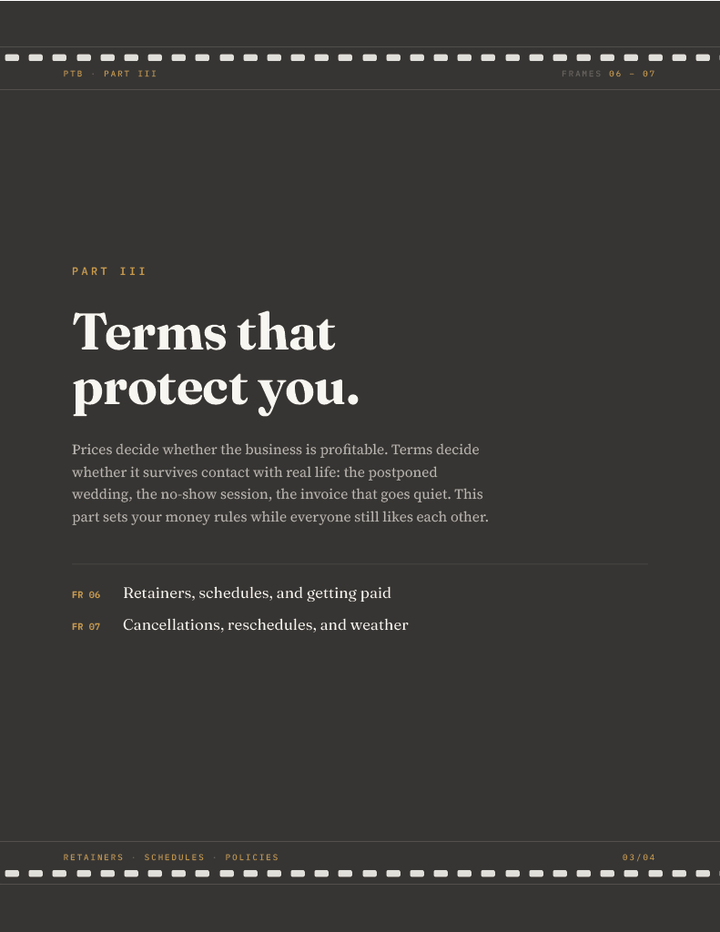
Frames 06-07Terms that protect you.

Part III

Terms that protect you.

Prices decide whether the business is profitable. Terms decide whether it survives contact with real life: the postponed wedding, the no-show session, the invoice that goes quiet. This part sets your money rules while everyone still likes each other.

  • FR 06 Retainers, schedules, and getting paid
  • FR 07 Cancellations, reschedules, and weather
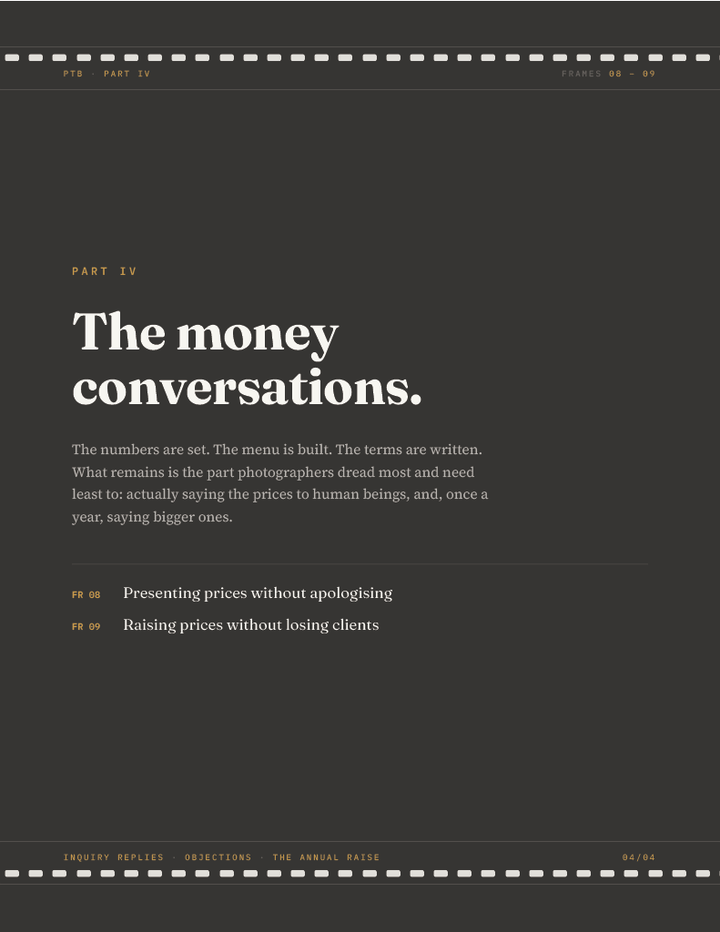
Frames 08-09The money conversations.

Part IV

The money conversations.

The numbers are set. The menu is built. The terms are written. What remains is the part photographers dread most and need least to: actually saying the prices to human beings, and, once a year, saying bigger ones.

  • FR 08 Presenting prices without apologising
  • FR 09 Raising prices without losing clients

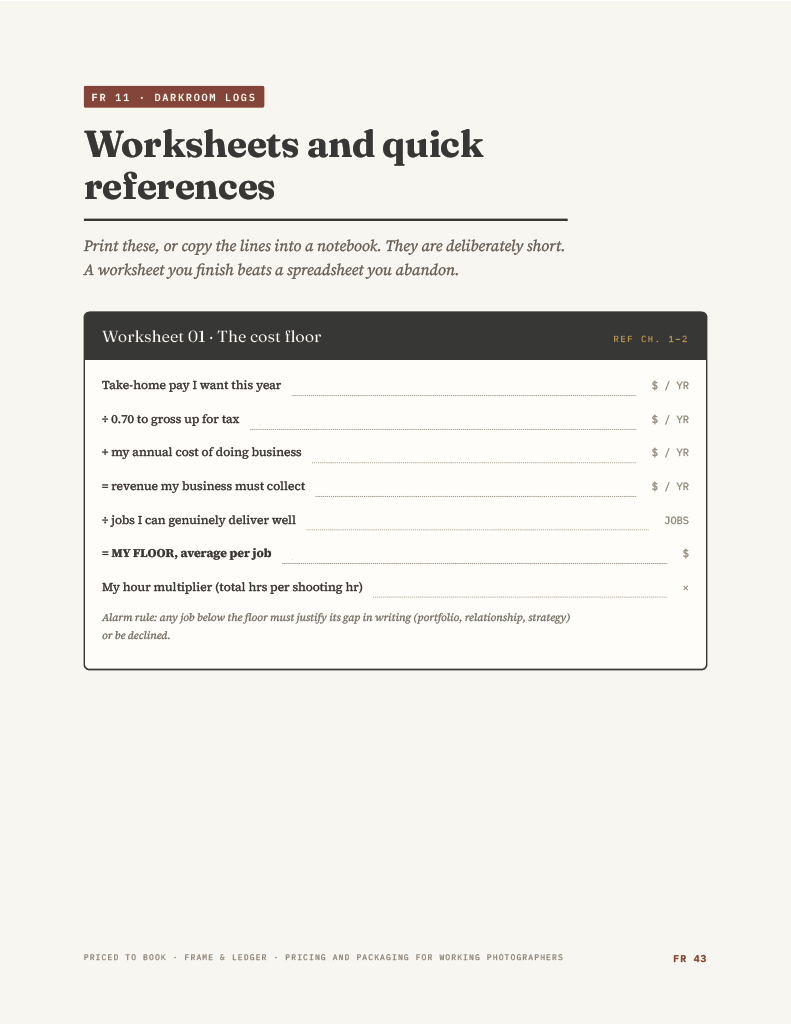
FR 11 · Darkroom logs

Four worksheets you actually finish.

Print these, or copy the lines into a notebook. They are deliberately short. A worksheet you finish beats a spreadsheet you abandon.

Four worksheets you actually finish.
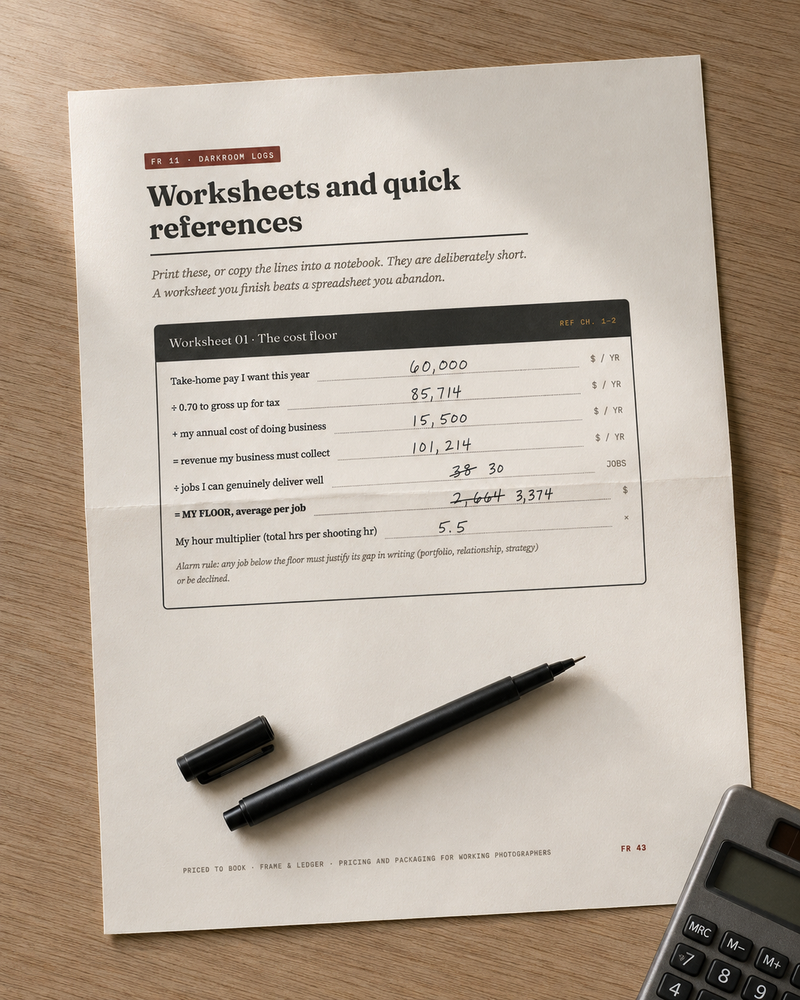
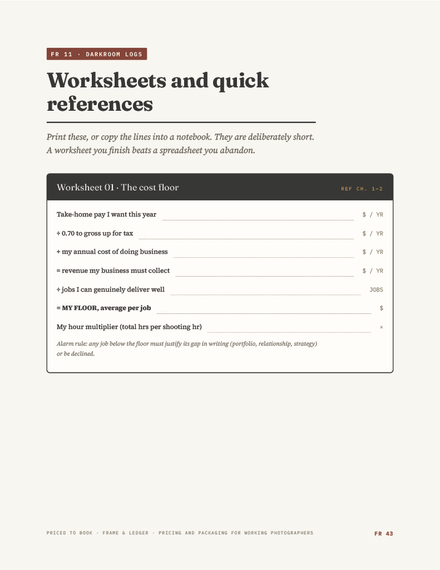
  1. 01 The cost floor Take-home pay, grossed up for tax, plus your real cost of doing business, divided by the jobs you can genuinely deliver well.
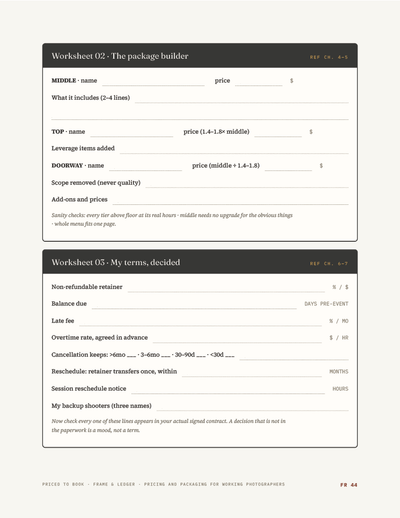
  2. 02 The package builder Middle tier first, top as anchor, doorway last. Spacing, add-ons, and three sanity checks.
  3. 03 My terms, decided Retainer, balance date, late fee, overtime rate, cancellation table, reschedule window, backup shooters.
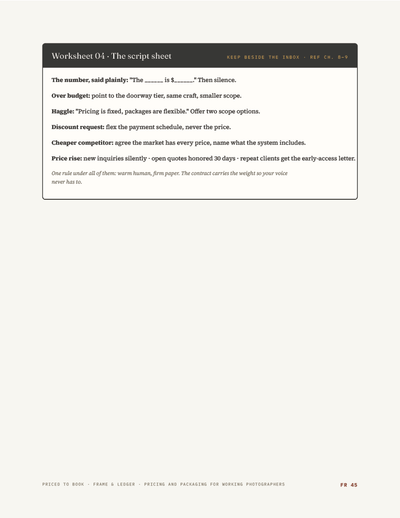
  4. 04 The script sheet Kept beside the inbox. The number said plainly, then every awkward reply after it.

A decision that is not in the paperwork is a mood, not a term.

FR 10 · The contact sheet

The 30-day pricing reset.

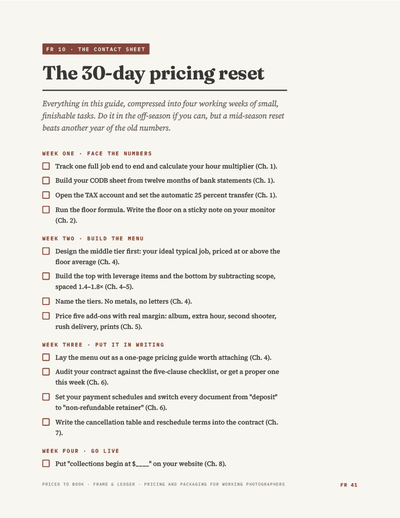
Everything in this guide, compressed into four working weeks of small, finishable tasks. Do it in the off-season if you can, but a mid-season reset beats another year of the old numbers.

  1. Week one

    Face the numbers

    • Track one full job end to end and find your hour multiplier
    • Build your cost-of-doing-business sheet from twelve months of statements
    • Open the tax account, set the automatic transfer
    • Run the floor formula. Put it on a sticky note
  2. Week two

    Build the menu

    • Design the middle tier first, your ideal typical job
    • Build the top with leverage, the bottom by subtracting scope
    • Name the tiers. No metals, no letters
    • Price five add-ons with real margin
  3. Week three

    Put it in writing

    • Audit your contract against the five-clause checklist
    • Set payment schedules; switch "deposit" to "non-refundable retainer"
    • Write the cancellation table and reschedule terms in
  4. Week four

    Go live

    • Put "collections begin at $____" on your website
    • Build the four-movement inquiry reply and save it
    • Rehearse the middle price out loud, with the silence after it
    • Book November's annual pricing review with yourself

  • 90 Minutes to read front to back
  • 30 Days from opening it to live prices
  • 03 Numbers written down by the last page

Before you buy

Who this is for, and who it isn't.

Buy it if

  • You book real jobs, weddings, portraits, events, brand, and you still can't say your price without flinching.
  • You have never actually calculated what a job costs you end to end.
  • You quote one number and lose the ones who wanted to spend more.
  • Your contract came from a Facebook group in 2019 and you have not read it since.
  • You have been meaning to raise prices for two seasons and keep not doing it.

Skip it if

  • You want to be told what to charge. This hands you the formula, not a rate card.
  • You have not shot a paid job yet. Start there, come back with real numbers.
  • You need legal advice. This is business education; contract law varies by state.
  • You already run a floor calculation, a tiered menu and an annual raise. You have this.
  • You want inspiration. It is short on inspiration and long on arithmetic.
Worksheet 01, the cost floor, printed and filled in by hand

The method

Where the numbers come from.

One thing this guide will not do is tell you what to charge. Anyone who does that without knowing your costs, your market, and your calendar is guessing.

Real ranges

Every figure is drawn from real US market ranges for wedding, portrait, event and brand work, and marked as a worked example to calibrate against, not a rate card to copy.

Two worked studios

The formulas run end to end on two full examples, a wedding studio and a portrait studio, so you can see where your own leak is before you touch your own spreadsheet.

Method, not mood

"Charge your worth" is a horoscope. Everything here is arithmetic you can do once and then defend for a season.

Written to be finished

Ninety minutes, eleven short chapters, four worksheets. It is built to be read once and reopened at the worksheets every time you touch your prices.

Not legal advice

Business education, not legal or accounting advice. Contract and tax matters vary by state. For anything binding, have a professional who knows your situation look it over.

From the roll

What changed after.

Ask every beta reader the same question: which number moved, and by how much.

A review that names a figure outsells five that say "so helpful".

  • 5 out of 5

    I ran the floor formula and got $2,900. I had been booking at $2,400 for three years. I moved the middle package to $3,600 and booked two at the new price in the first month. Nobody asked why.

    Danielle R.

    Asheville, NC · Weddings

  • 5 out of 5

    I thought I knew my prices. I did not know my prices. The hours table alone showed me I was spending five and a half hours on a session I had been calling a one-hour job. I would have paid the $34 for that page on its own.

    Marcus T.

    Columbus, OH · Portraits

  • 5 out of 5

    I bought it expecting another "charge your worth" pep talk and nearly asked for the refund before opening it. It is a spreadsheet in book form, which is what I actually needed. Took me one evening. My add-ons make money now.

    Priya S.

    Sacramento, CA · Events & brand

The guarantee

14 days · No forms

Read it. Do the two calculations in Part One. If fourteen days later your prices are exactly where they were and you can point at why the method didn't fit your business, email me and I'll refund the $58.

Keep the file. Chasing a download back is not worth either of our afternoons, and a guide about honest numbers should not be sold on a technicality.

Fourteen days, one email.

  • No questionnaire
  • No "have you tried" reply
  • No retention offer

Questions

Before you decide.

How do I get it?

Checkout takes a card, then the download link arrives by email. It is a PDF, so it opens on a phone, a laptop, or a printer.

Does this tell me what to charge?

No, and that is deliberate. It gives you the formula that turns your costs, your calendar, and the income you want into your own numbers. Every figure in the book is a worked example to calibrate against, not a rate card to copy.

I shoot portraits, not weddings. Does it still apply?

Yes. The method runs on weddings, portraits, events, and brand work, and the sample menus cover weddings and portraits in full.

Are the contracts included?

Not in this guide. Chapters 6 and 7 give you the terms and the clauses your contract should carry. The ready-to-send contract templates are a separate pack.

I'm outside the US. Is it still useful?

The arithmetic does not care about currency, and the method is the same anywhere. The dollar figures are drawn from US market ranges, so treat them as calibration rather than local rates.

Is this legal advice?

No. It is business education. Contract and tax matters vary by state, so for anything binding, have a professional who knows your situation look it over.

How long does it take to work through?

About ninety minutes to read front to back. The worksheets are built to be reopened every time you touch your prices, and the closing chapter lays the work out over four weeks.

What if it doesn't help?

Email within fourteen days and you get a refund, no questionnaire and no retention offer. Keep the file either way.

Before you go

Three numbers, written down.

Your floor. Your middle package. The date of your next raise. If those three exist on paper when you close this guide, the ninety minutes did their work, and the next inquiry that lands in your inbox meets a photographer who has already done the arithmetic.

$58 NZD · PDF · 46 pages